

What a project is
A project is the group of instances in one organization that share a config repository. It stores shared settings and gives the dashboard and CLI one place to inspect or update its instances together. Think of the distinction between a Fly App and its Machines: the project is the group; an instance is an independently managed unit. Docker Compose also uses a project to group resources, but a Tinfoil instance can itself run multiple application containers inside one enclave. These are naming parallels, not equivalent networking or scaling models.Creating a project
A project is created implicitly when you create the first instance from a repository, or create its project-secret namespace. There is no separatetinfoil project create step. Use tinfoil container create to create an instance, not to import source code.
A config repository discovered through the GitHub App is a source, not proof that you have a managed project or a running instance. The project is the home for its instances and shared settings; the source editor manages config PRs and releases. Publishing a source release does not deploy it.
In Containers → Projects, the Container projects page lists managed projects separately from Available configurations. Set up project guides you through source setup; the group itself appears after its first instance or project secret. Open a project to inspect its instances, source connection, hold default, secrets, and releases. To create from a published tag, choose Create instance from this release beside that tag.

A project for the hello-world example with two running instances.
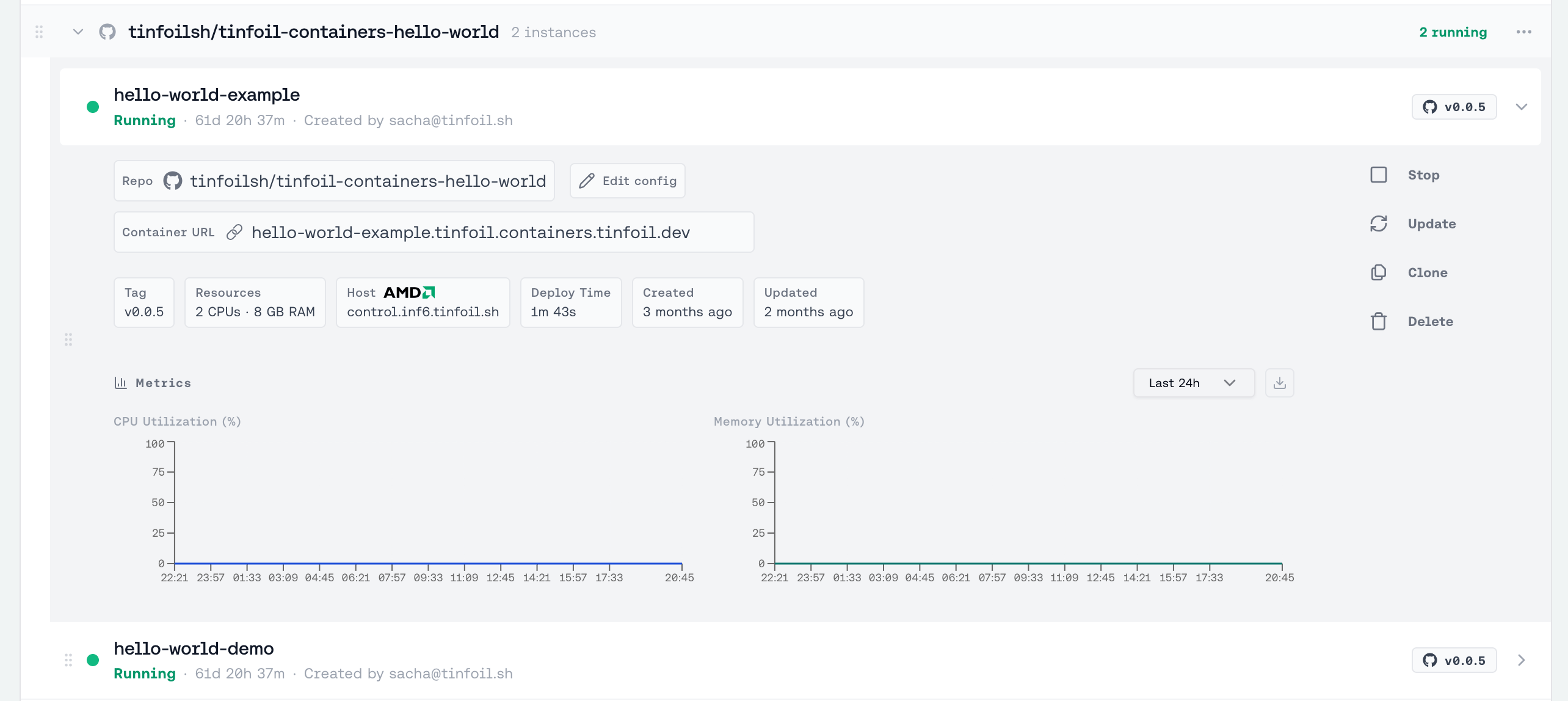
Both instances run the same repo and tag but have different names.
Inspecting a project
Use either the project UUID or itsowner/repo name:
-o json for machine-readable output.
Project settings
To hold new versions for review by default on every update of this project:hold_by_default=false. Individual instance updates, edited-config updates, and batch project updates inherit it. An explicit --hold=true or --hold=false overrides it for that operation only, without changing the project setting. Creates and deploys are never held. See Holding an update for review.
Manage secrets for the same project from its Project secrets section under Containers → Projects in the dashboard. See Secrets & environment variables for scope and naming rules.
Updating every instance
See Updating to update every instance, or a selected set, to the same release.Creating another instance
Open the project’s menu in the dashboard and choose New instance from this config, or runtinfoil container create with the same --repo. Each instance is managed on its own; there is no shared endpoint across instances.